
ACDI Postdocs Strengthen Participatory Research Skills at Pan-African Workshop

Two postdoctoral researchers and a PhD candidate from the African Climate and Development Initiative (ACDI) recently took part in a dynamic, continent-wide learning experience that underscores the institute’s commitment to building early-career research (ECR) capacity and advancing inclusive, community-centred approaches to knowledge production.
Dr Vuyisile Moyo, Dr Chipo Mungenge and Nicola Rule attended the Innovative Participatory Research Methods Workshop, hosted by the University of Western Cape (UWC), Politics and Urban Governance Research Group (PUG), funded by the Mastercard Foundation, University of Cambridge Climate Resilience and Sustainability Research Fund. Understanding that most climate resilience and sustainability research has relied on traditional research methods such as surveys, interviews and data modelling, this workshop brought together emerging and established scholars from across Africa to explore participatory methodologies (photovoice, storytelling) that centre lived experience and amplify the voices of communities often excluded from traditional research processes. The workshop was practical and hands-on, with participants developing their own practical stories. This was amplified by a site visit in Khayelitsha where there was a photovoice exhibition by community members.
For ACDI, supporting postdoctoral researchers to engage in such spaces is a key part of our broader mission: equipping early-career scholars with the tools, networks, and perspectives needed to become excellent future leaders in research, policy and practice. As research increasingly intersects with social realities, interdisciplinary collaboration and community engagement are becoming essential components of impactful scholarship.
Reflecting on the experience, Dr. Mungenge, a postdoc with the PiNC lab, described the workshop as a powerful learning space where tools like Photovoice and storytelling enable community members to frame their own environment, their struggles, and their hopes.
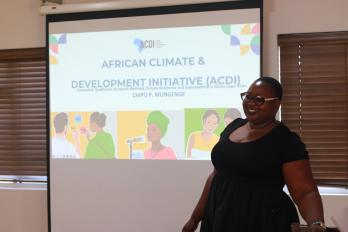
“These methods shift the narrative and give people the agency to define what truly matters to them,” she noted. “In informal settlements, where physical and social structures are constantly changing, such tools become vital instruments of documentation and self‑representation. Adopting these approaches also requires humility allowing communities to lead the narrative and recognising them as co‑creators, narrators, and owners of their own stories.”
The Workshop was a great opportunity to grapple with ways of doing research that have a meaningful impact beyond academia through outputs like photo exhibitions and stories that can be widely shared.” explained Nicola Rule, a PhD candidate working with the Climate Risk Lab, “I thoroughly enjoyed learning from and with ECRs from across Africa who are all thinking about climate change from different angles.”
The experience aligns closely with ACDI’s strategic focus on addressing climate change and development challenges through approaches that are not only scientifically robust but also socially grounded. As issues such as climate change, health, and urban development become increasingly interconnected, the need for research that centres community voices and local knowledge have never been more urgent.

Reflection on the experience, Dr Moyo, a postdoc on the HABVIA project, explained that “as someone working at the intersection of climate change adaptation, health and community development, photovoice and storytelling reminded me that an image and a story can communicate lived realities that statistics alone cannot capture. A key takeaway for me was how powerful an image and a story can shift power in the research process by allowing communities to speak for themselves”.
By investing in opportunities like this workshop, ACDI continues to strengthen its role as a hub for innovative, interdisciplinary research and capacity building. The participation of our early career researchers highlights the importance of supporting ECRs to engage with new methodologies, expand their perspectives, and contribute to a more inclusive and impactful research landscape.